
Anjeer
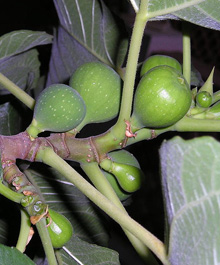 The common fig (Ficus carica) is a species of flowering plant in the genus Ficus, from the family Moraceae, known as the common fig, or just the fig. It is the source of the fruit also called the fig, and as such is an important crop in those areas where it is grown commercially. Native to the Middle East and western Asia, it has been sought out and cultivated by man since ancient times, and is now widely grown throughout the temperate world, both for its fruit and as an ornamental
Description
It is a monoecious, deciduous tree or large shrub, growing to a height of 6.9–10 metres (23–33 ft), with smooth grey bark. Its fragrant leaves are 12–25 centimetres (4.7–9.8 in) long and 10–18 centimetres (3.9–7.1 in) across, and deeply lobed with three or five lobes. The complex inflorescence consists of a hollow fleshy structure called the syconium, which is lined with numerous unisexual flowers. The flower itself is not visible outwardly, as it blooms inside the infructescence. Although commonly referred to as a fruit, the fig is actually the infructescence or scion of the tree, known as a false fruit or multiple fruit, in which the flowers and seeds are borne. It is a hollow-ended stem containing many flowers. The small orifice (ostiole) visible on the middle of the fruit is a narrow passage, which allows the specialized fig wasp to enter the fruit and pollinate the flower, whereafter the fruit grows seeds.
The edible fruit consists of the mature syconium containing numerous one-seeded fruits (druplets).[3] The fruit is 3–5 centimetres (1.2–2.0 in) long, with a green skin, sometimes ripening towards purple or brown. Ficus carica has milky sap (laticifer). The sap of the fig's green parts is an irritant to human skin.
The genus Dorstenia, which, like the fig, is in the mulberry family (Moraceae), exhibits similar tiny flowers arranged on a receptacle but in this case the receptacle is a more or less flat, open surface. It is a structure intermediate between the fig and the mulberry, where the fig corresponds in structure to an invaginated or inside-out mulberry.
Habitat
The Common fig tree has been cultivated since ancient times and grows wild in dry and sunny areas, with deep and fresh soil; also in rocky areas, from sea level to 1,700 meters. It prefers light and medium soils, requires well-drained soil, and can grow in nutritionally-poor soil. Like all fig trees, Ficus carica requires wasp pollination of a particular species of wasp to produce seeds. The plant can tolerate seasonal drought, and the Middle Eastern and Mediterranean climate is especially suitable for the plant. Situated in a favorable habitat, old specimens when mature can reach a considerable size and form a large dense shade tree. Its aggressive root system precludes its use in many urban areas of cities, but in nature helps the plant to take root in the most inhospitable areas. Common fig tree is mostly a phreatophyte that lives in areas with standing or running water, grows well in the valleys of the rivers and ravines saving no water, having strong need of water that is extracted from the ground. The deep-rooted plant searches groundwater, in aquifers, ravines, or cracks in the rocks. The fig tree, with the water, cools the environment in hot places, creating a fresh and pleasant habitat for many animals that take shelter in its shade in the times of intense heat.
Cultivation
The common fig is grown for its edible fruit throughout the temperate world. It is also grown as an ornamental tree, and the cultivar 'Brown Turkey' has gained the Royal Horticultural Society's Award of Garden Merit. Figs can be found in continental climates with hot summers as far north as Hungary and Moravia, and can be harvested up to four times per year. Thousands of cultivars, most named, have been developed as human migration brought the fig to many places outside its natural range. Two crops of figs are potentially produced each year.[7] The first or breva crop develops in the spring on last year's shoot growth. In contrast, the main fig crop develops on the current year's shoot growth and ripens in the late summer or fall. The main crop is generally superior in both quantity and quality to the breva crop. However, some cultivars produce good breva crops (e.g., 'Black Mission', 'Croisic', and 'Ventura').
Read More