
Apricot
-
The apricot, Prunus armeniaca, is a species of Prunus, classified with the plum in the subgenus Prunus. The native range is somewhat uncertain due to its extensive prehistoric cultivation.
Description
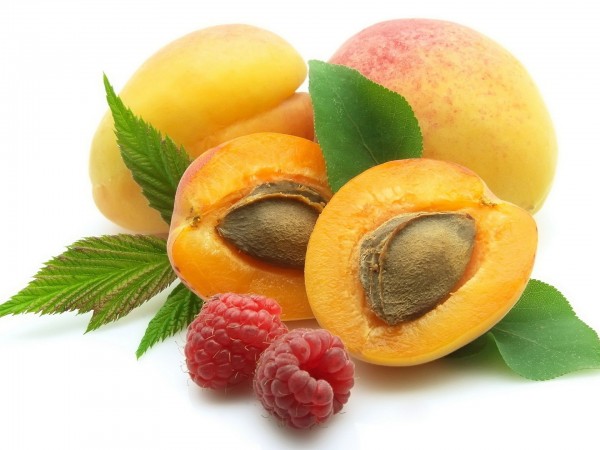
The apricot is a small tree, 8–12 m (26–39 ft) tall, with a trunk up to 40 cm (16 in) in diameter and a dense, spreading canopy. The leaves are ovate, 5–9 cm (2.0–3.5 in) long and 4–8 cm (1.6–3.1 in) wide, with a rounded base, a pointed tip and a finely serrated margin. The flowers are 2–4.5 cm (0.8–1.8 in) in diameter, with five white to pinkish petals; they are produced singly or in pairs in early spring before the leaves. The fruit is a drupe similar to a small peach, 1.5–2.5 cm (0.6–1.0 in) diameter (larger in some modern cultivars), from yellow to orange, often tinged red on the side most exposed to the sun; its surface can be smooth (botanically described as: glabrous) or velvety with very short hairs (botanically: pubescent). The flesh is usually firm and not very juicy. Its taste can range from sweet to tart. The single seed is enclosed in a hard, stony shell, often called a "stone", with a grainy, smooth texture except for three ridges running down one side./p>
Cultivation and uses
History of cultivation
 The apricot was known in Armenia during ancient times, and has been cultivated there for so long, it is often thought to have originated there.[4][5] Its scientific name Prunus armeniaca (Armenian plum) derives from that assumption. For example, De Poerderlé, writing in the 18th century, asserted, "Cet arbre tire son nom de l'Arménie, province d'Asie, d'où il est originaire et d'où il fut porté en Europe ..." ("this tree takes its name from Armenia, province of Asia, where it is native, and whence it was brought to Europe ...").[6] An archaeological excavation at Garni in Armenia found apricot seeds in an Eneolithic-era site.[7] Despite the great number of varieties of apricots that are grown in Armenia today (about 50),[5] according to Vavilov its center of origin would be the Chinese region, where the domestication of apricot would have taken place. Other sources say that the apricot was first cultivated in India in about 3000 BC.[8]
Its introduction to Greece is attributed to Alexander the Great;[8] later, the Roman General Lucullus (106–57 B.C.) also would have imported some trees – the cherry, white heart cherry, and apricot – from Armenia to Rome[citation needed]. Subsequent sources were often confused about the origin of the species. Loudon (1838) believed it had a wide native range including Armenia, Caucasus, the Himalaya, China, and Japan.[9]
Apricots have been cultivated in Persia since antiquity, and dried ones were an important commodity on Persian trade routes. Apricots remain an important fruit in modern-day Iran, where they are known under the common name of zard-ālū (Persian: زردآلو).
Egyptians usually dry apricots, add sweetener, and then use them to make a drink called amar al-dīn.
More recently, English settlers brought the apricot to the English colonies in the New World. Most of modern American production of apricots comes from the seedlings carried to the west coast by Spanish missionaries. Almost all U.S. commercial production is in California, with some in Washington and Utah.
The apricot was known in Armenia during ancient times, and has been cultivated there for so long, it is often thought to have originated there.[4][5] Its scientific name Prunus armeniaca (Armenian plum) derives from that assumption. For example, De Poerderlé, writing in the 18th century, asserted, "Cet arbre tire son nom de l'Arménie, province d'Asie, d'où il est originaire et d'où il fut porté en Europe ..." ("this tree takes its name from Armenia, province of Asia, where it is native, and whence it was brought to Europe ...").[6] An archaeological excavation at Garni in Armenia found apricot seeds in an Eneolithic-era site.[7] Despite the great number of varieties of apricots that are grown in Armenia today (about 50),[5] according to Vavilov its center of origin would be the Chinese region, where the domestication of apricot would have taken place. Other sources say that the apricot was first cultivated in India in about 3000 BC.[8]
Its introduction to Greece is attributed to Alexander the Great;[8] later, the Roman General Lucullus (106–57 B.C.) also would have imported some trees – the cherry, white heart cherry, and apricot – from Armenia to Rome[citation needed]. Subsequent sources were often confused about the origin of the species. Loudon (1838) believed it had a wide native range including Armenia, Caucasus, the Himalaya, China, and Japan.[9]
Apricots have been cultivated in Persia since antiquity, and dried ones were an important commodity on Persian trade routes. Apricots remain an important fruit in modern-day Iran, where they are known under the common name of zard-ālū (Persian: زردآلو).
Egyptians usually dry apricots, add sweetener, and then use them to make a drink called amar al-dīn.
More recently, English settlers brought the apricot to the English colonies in the New World. Most of modern American production of apricots comes from the seedlings carried to the west coast by Spanish missionaries. Almost all U.S. commercial production is in California, with some in Washington and Utah.