
Pista Badam
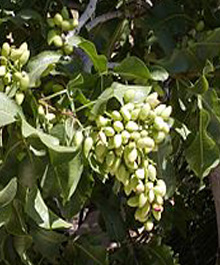 The pistachio, Pistacia vera in the Anacardiaceae family, is a small tree originally from Greater Iran (Iran and Iraq[1][2]) which now can also be found in regions of Syria, Lebanon, Turkey, Greece, Tunisia, Kyrgyzstan, Tajikistan, Turkmenistan, India, Pakistan, Egypt, Italy (Sicily), Uzbekistan, Afghanistan (especially in the provinces of Samangan and Badghis), and the United States, specifically in California. The tree produces an important culinary nut.
Pistacia vera often is confused with other species in the genus Pistacia that are also known as pistachio. These species can be distinguished from P. vera by their geographic distributions (in the wild) and their nuts which are much smaller, have a strong flavor of turpentine, and have a shell that is not hard.
History
Archeologists have found evidence from excavations at Jarmo in northeastern Iraq[1] that pistachio nuts were a common food as early as 6750 BC.[1] The Hanging Gardens of Babylon were said to have contained pistachio trees during the reign of King Merodach-Baladan about 700 BC.[1] The modern pistachio nut P. vera was first cultivated in Western Asia, where it has long been an important crop in cooler parts of Iran and Iraq. It appears in Dioscurides as pistakia πιστάκια, recognizable as P. vera by its comparison to pine nuts.[3] Its cultivation spread into the Mediterranean world by way of Iran from Syri
Pliny in his Natural History asserts that pistacia, “well known among us,” was one of the trees unique to Syria, and that the nut was introduced into Italy by the Roman consul in Syria, Lucius Vitellius the Elder (consul in Syria in 35 AD) and into Hispania at the same time by Flaccus Pompeius.[4] The early sixth-century manuscript De observatione ciborum (“On the observance of foods”) by Anthimus implies that pistacia remained well known in Europe in Late Antiquity. The pistachio is one of three nuts mentioned in the Bible. The pistachio is mentioned once, in Genesis 43:11, as is the walnut in Song of Songs 6:11, while the almond is mentioned many times.
Cultivation
Iran, the United States and Turkey are the major producers of pistachios.[2] The trees are planted in orchards, and take approximately seven to ten years to reach significant production. Production is alternate bearing or biennial bearing, meaning the harvest is heavier in alternate years. Peak production is reached at approximately 20 years. Trees are usually pruned to size to make the harvest easier. One male tree produces enough pollen for eight to twelve nut-bearing females. Harvesting in the United States and in Greece is often accomplished by using shaking equipment to shake the nuts off the tree. After hulling and drying, pistachios are sorted according to open mouth and closed mouth shell. Sun drying has been found to be the best method of drying.[13] Then they are roasted or processed by special machines to produce pistachio kernels.
Read More